Reflection
The Part of You That Already Knows
The Maze had no laws until I invented them.
That was the part I thought would be hard, and in fairness, it was. Black stone, shifting corridors, fog that rises when you stand still — none of it exists, and none of it obeys any laws until I write them. I’m much more comfortable writing a place I can see. A room. A coastline. A dock at low tide.
So I finished the chapter and then kept reopening it, reading the same passages over and over, the way you listen back to a recording of your own voice.
Parts of it I loved. Others I rewrote. Again. And again. I kept asking myself: Does this make sense? Is the Maze interesting? Will readers follow the mechanics?
Two things turned out to be true, and neither was what I’d originally been worried about.
The first was that my unease had nothing to do with the Maze. It was the writing style and rhythm.
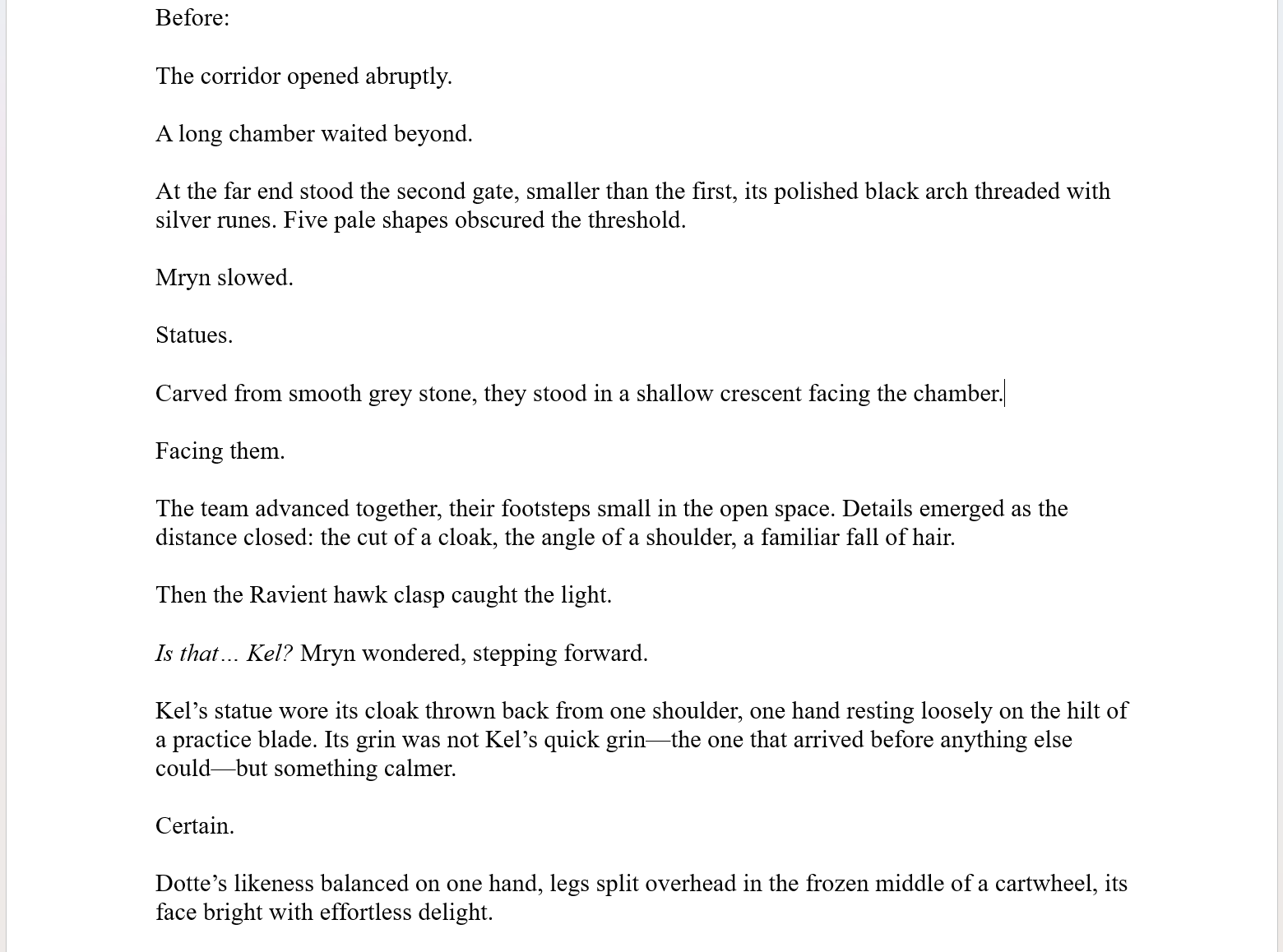
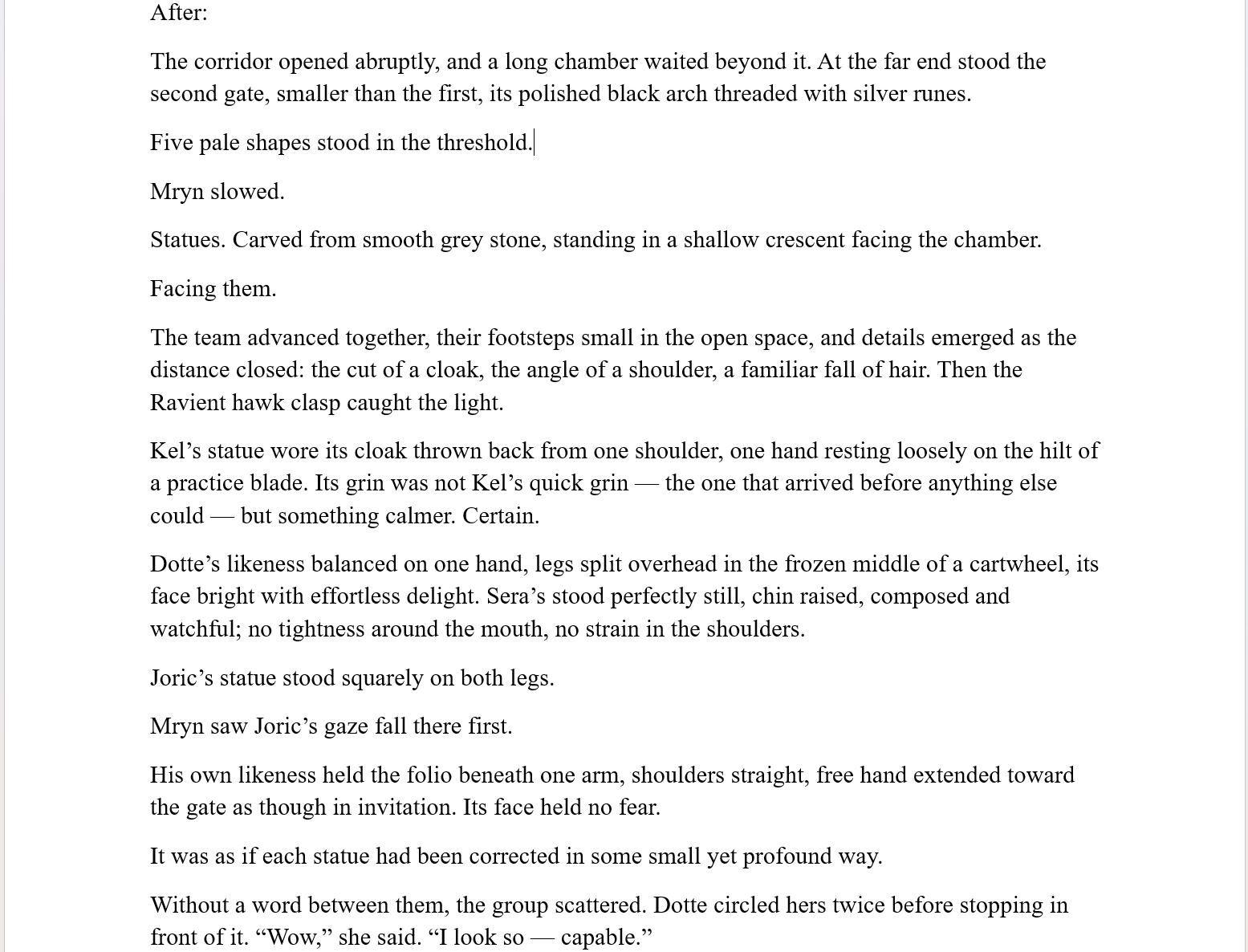
Somewhere in these chapters I’d started writing short.
Hard.
One line at a time.
Like this.
Not every line — but enough that when I looked back I could see a change. This sort of clipped style can be good for pacing, and there are writers who’ve built careers on it. But I’d drifted into it without deciding to, and the end result was a style that felt somehow unfamiliar — a style that for all the fast pacing, felt fragmented and abrupt. When every line is a hammer, you stop noticing the hammer.
The second truth was even more impactful.
I’d spent several chapters teaching the reader that the Maze cannot be forced. That it takes only what you offer it freely. And then, at the end, I let my main character walk out of it without paying a price.
To be fair, this happened at the end of a long 7500+ word session. Nobody warns you that fatigue has its own gravity, or that it pulls hardest in the last thousand words. When you can see the finish line and you want to be done, sometimes you write the ending that gets you there fastest.
So I stopped. Slept. Came back. And nobody had to point it out to me — I could see it immediately.
I went back and made his final choice come at a cost, one that means something. It’s a better chapter now. It cost me the ending I thought I had, but it now feels complete.
What I’m taking from this is to trust the instinct. If you find yourself revisiting something over and over, there’s probably a reason — and it might have nothing to do with what’s bothering you on the surface. Step back. Get some rest (really get some rest). Come back with fresh eyes.
The uneasy feeling usually isn’t a verdict on the work. Most of the time it’s the part of you that already knows, waiting for the rest of you to catch up.